Total screen time explains almost nothing
It is still the number nearly every app on the market puts front and centre — and the one families argue over.
Live demo · Czech interface
ReBalance shows a family the rhythm of its day with the phone — and helps them agree on it. It never blocks, never diagnoses and never compares you to “the average user”.
Just an e-mail. Nothing to install, it runs in the browser — and the first 1,000 people get a free year at launch.
Why differently
Every parent knows phone time is an issue. The uncomfortable part is what monitoring does about it. A 2025 meta-analysis of 571 studies and over two million participants found the strongest links to outcomes in what the parent knows and what the child volunteers. The weakest: how much the parent asks. Control on its own is not what does the work — the child’s willingness to talk is.
It is not about how many hours. An umbrella review of more than a hundred meta-analyses found only small effects for total screen time — in both directions. The risk shows up once you stop counting the amount and start looking at the pattern. So ReBalance does not measure hours. It measures the rhythm: when the phone is used, what it is used for, and what it displaces.
It is still the number nearly every app on the market puts front and centre — and the one families argue over.
Restrictive rules push teenagers towards concealment. The parent then loses even the visibility they had before.
So ReBalance does not optimise for how much the parent knows. It optimises for how willing the child is to talk. Every feature is judged by that.
The link between parental pressure and concealment is documented in the same meta-analysis of parental monitoring: Pinquart & Reeg 2025, Substance Use & Misuse
What makes it different
Each rests on the literature rather than on product instinct — and each is actually implemented in the app, not promised.
We track the rhythm: how often the phone is opened, how much time falls after eleven at night, how much of it is passive scrolling.
Two better numbers in a row are noise, not a trend. The app stays quiet about improvement until it has at least three measurements and a change larger than half a standard deviation.
Mann–Kendall, 0.5 SD threshold
The app enforces no rules. It names an agreement instead — five points the family writes together around one phone.
From age ten there is a permanently available screen, “What my parent sees about me”, with the same content as the parent dashboard. A hidden monitoring mode does not exist and never will.
Enforced on the server, not in the UI
No messages, no contact names, no location. From age ten not even individual app names — only categories. For teenagers the parent does not see questionnaire answers either.
Filtered on the server, not in the app
Children copy the pattern they see at home rather than the rule they hear. A plan where only the child has rules is one the app refuses to save.
What the app does
It runs as a web app for both parent and child, and as a native Android app — the only part that can read actual time spent in applications.
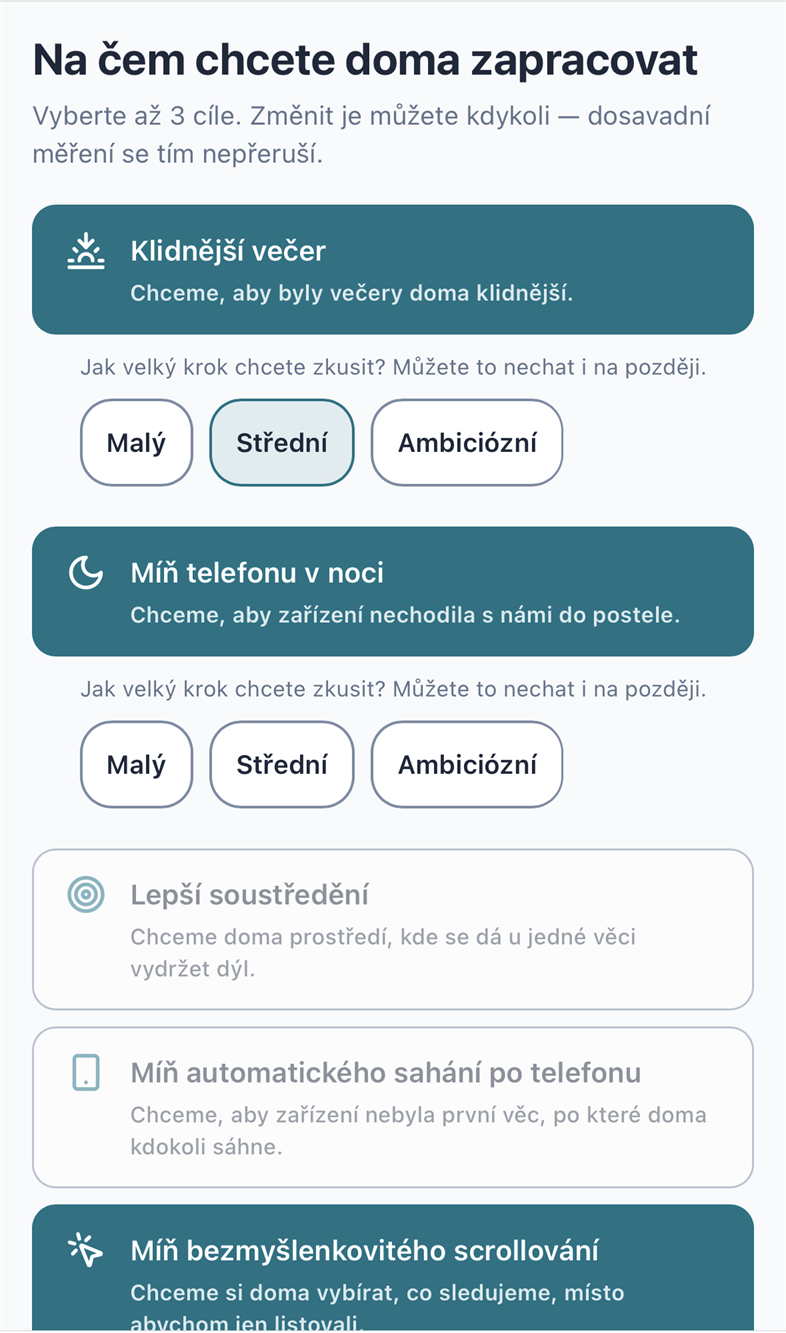


For young children the parent answers; from age ten the child answers alone. Validated psychometric scales; language and scope change with age.
Weekly rhythm, app categories, trend. It speaks plainly about deterioration and stays quiet about improvement until it can evidence it.
Five points, at least one of which binds the parent. From age ten the child approves each point or marks disagreement in their own words. The objection is stored, both sides see it, and it does not void the agreement.
After four weeks the agreement reopens. Proposal, counter-proposal and consensus stay in the history, so it is visible whose wording won.
The child signs in with a pairing code and sees their own numbers, the agreement, and a list of what the parent cannot see. That list is a screen of its own, not a footnote.
The app names what happened and follows it straight away with what to do about it. It never says the child did something wrong — not even on an alert flagged as serious.
The native app reads time spent in applications and uploads summaries only. No content, no location.
Helpline contacts are always available in the app, not triggered by a score. Nothing is reported anywhere and nothing is logged.
This is what a parent alert looks like “Today ran over the agreed time. 260 minutes on the phone today; 180 was the agreement. Worth a look together, not a telling-off.”
Try it
Open it in a browser — on a phone you can add it to the home screen and it behaves like a normal app. The account is shared and demo-only; the data is invented but the patterns in it are real. The interface is Czech.
The first 1,000 users get a free year once we launch on Google Play. Leave us your e-mail and we will let you know the moment it is downloadable — we expect within 30 days. Demo access is yours right away.
Where we are
We would rather say it up front than have you discover it by clicking.
Pricing
These prices are an intention, not an offer — the payment flow is not finished. Until it is, the app is available as a trial with no card details required.
free 14 days
€7.99 per month
on request schools, clinics, employers
No tier sells data. Analysis runs on the server and message content never enters the app at all.
Who is behind it
Strategy and product
Keeps the product from claiming more than it can evidence.
Research and psychology
Owns the knowledge base — every sentence in the app has a source.
Business and finance
Partnerships, operations, and keeping the project standing long term.
Contact
We are looking for families for the pilot, expert reviewers, and partners among schools and clinics. Write to us — we answer personally.